
Through some hazy childhood memory, I can see faces glaring at me over dining tables and teachers’ desks. Disapproving glares magnified by 1980’s spectacle lenses furiously melting any hope of my voice being heard in the next few minutes. Scorn, anger, and derision rained down in Biblical showers from their mouths, as the value of whatever I wanted to say was nullified and rejected, not for any other reason than the way I had said it was in some way abhorrent to their ears.
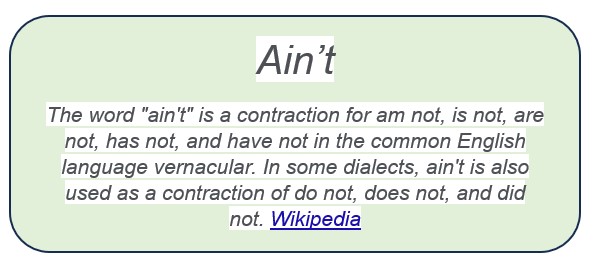
What seemed particularly unfair was that ‘ain’t’ as a contracted verb was, as far as I was concerned, not only a word but one which was in common usage. Socially, my friends were quite comfortable with using ‘ain’t’ as often as possible as a substitute for ‘isn’t’ and ‘haven’t’ without any concern that it might not be correct. ‘Ain’t it?’ was part of a little family of interrogative phrases which included ‘wern it?’, ‘arn it?’, and ‘cudden it?’ which in my 8 year-old world were not only socially acceptable, but probably the only way of expressing enquiry. ‘Ain’t’ was particularly useful because it could be used repeatedly for different purposes: “It ain’t, ain’t it?” or “We ain’t got one’” being useful examples.
For a short time in my life, one phrase above all cut through my self-worth and left it scattered in fragments of confusion: “Ain’t is not a word”.
Clearly this cut deep and left an everlasting impression that I accepted blindly as received knowledge and wisdom. For the last 40 years, I have not only accepted that ‘ain’t isn’t a word’ but I have repeated it to others and become a foot soldier in the quest to eradicate ‘ain’t’ from the world forever. Not once, until now, have I ever thought to question the complicated web of thinking that lies behind sending ‘ain’t’ to Room 101, or whether or not it’s right that it should be there. In addition, why in a household of Welsh parents where, “over by there” (over there), “funedral” (funeral) and “vawse” (vase) were apparently accepted language variations, which I was allowed to use liberally, was ‘ain’t’, a variation of my own social experience, given such special condemnation?
In a nutshell, the answer to this quandary is relatively simple. Ain’t was a victim of social snobbery. It was singled out in the contraction family and labelled as a vernacular horror to separate those that ‘know’ and those that ‘don’t’. It unwittingly entered the world of social constructs and became a symbol of those not fortunate enough to be part of the inner circle who know never to use it in writing or conversation. ‘Ain’t’ became a symbolic label in a class system where the “uncultured” were left unheard and derided. As such, the furious glares and reproving looks were wrong when they announced so conclusively that ‘Ain’t isn’t a word’. What they should have said was that “Ain’t isn’t a word that anyone who wants their opinions to be taken seriously should use, and that by using this word in your writing, you are unwittingly ensuring that that you cannot express what you want to say with any gravity whatsoever.”
In a world where cultural capital is a construct of the middle classes (Diane Rey) created to ensure their continue success through the adherence to grammatical rules which they have approved and through the enjoyment of experiences which they have deemed appropriate and life-enhancing, ‘ain’t’ is a symbol of the failure of the disadvantaged to succeed in a world where it forms part of Bernstein’s restricted code of the working classes which has limited vocabulary and is based on the use of short, unfinished, grammatically simple short sentences which is contrasted unfavourably to the elaborated code used by the middle classes where there is a wider vocabulary based on longer and grammatically complex sentences.
Recently, in hearing and watching a child repeatedly use the word ain’t both in speech and in writing, I have been overcome with sadness for several reasons. I now understand, as she does not, that ‘ain’t’ is a word which she is more than entitled to use to express herself and that it has evolved with equal validity as any other word in the English Language, however, for reasons linked only to social engineering, this is a word which has been vilified and which exposes her as a disadvantaged pupil and has repercussions which will limit her dreams and aspirations.
I know and understand that like so many dialectical phrases, although this word links her to a place and a heritage which holds great value, these are not values held by a wider ‘ruling’ society who have set their own language expectations upon grammar and have ensured that by not adhering to those rules many people are barred from progressing educationally.
I also know, that with a certain reluctance, I need to play my part in eradicating ‘ain’t’ from this little girl’s vocabulary, not because I think it is right that this word should be worth less than any other or because it’s culture and heritage is worth less than any other, but because if I want this person to achieve her full potential in future, I need to ensure that she knows how to speak and write in a manner that will ensure that her voice is heard and taken seriously, not mocked and disparaged for innocently daring to use vocabulary tabooed by a world of which she has no knowledge or understanding.
The National Curriculum Aims for English are to “promote high standards of language and literacy by equipping pupils with a strong command of the spoken and written language.” This includes the aim of ensuring that pupils “acquire a wide vocabulary, an understanding of grammar and knowledge of linguistic conventions for reading, writing and spoken language.” Furthermore, pupils are required to “write clearly, accurately and coherantly, adapting their language and style in and for a wide range of contexts, purposes and audiences.”
Whilst dialects are not expressly prohibited by the National Curriculum, it is clear that through the requirement to use lingustic conventions, a person who habitually writes or speaks in a dialect is working contrary to the ‘accepted norm’ of the English language. In England, there are approximately 45 dialects currently in existence. Through the universal prevalence of social media and the country wide predominance of television presenrtes with South-East regional accents and an elaboraded code of grammatical usage, the linguistic norms of the country work subversively to exclude the user of dialectical terms on a linguistic and social scale.
Ironically perhaps, when writing according to linguistic conventions, the ability to write dialogue in a manner which conveys the character’s origins through dialect is highly prized and considered skillful. This in itself is a lingustic covention which brings to mind the comic juxtaposition of an Edwardian play where the speech of the ‘superior’ characters would be the envy of any Etonian whereas the comic relief is provided by the domestic personal who chatter away in a jolly vernacular – a situation which both reinforces social sterotypes through language and belittles the restrictde code of the working classes. By way of example,” I ain’t putting the funedral vawse over by there.” Is a phrase that would be more likely to be the spoken by a maid than by Mrs Dalloway, indeed would Mrs Dalloway even understand what was going on in such a situation, with such a menial task being as much beneath her as the language usage itself?
One of the aims of the National Curriculum is, of course, that pupils acquire a wide range of vocabulary, for a wide range of purposes. What I would say is this, whilst we are developing our understanding of etymology and adding to our cannon of more ambitious and more specific vocabulary, let’s ensure that we leave room for a few dialectical phrases from an older England before they are lost for ever: hoddy-doddy (snail); hodgepig (hedgehog) and Bishy Barnabee (Ladybird) deserve a place in the vocabulary of the future however uniform and selective that may be.
 Bring colour to a monochrome journey
Leave a comment