
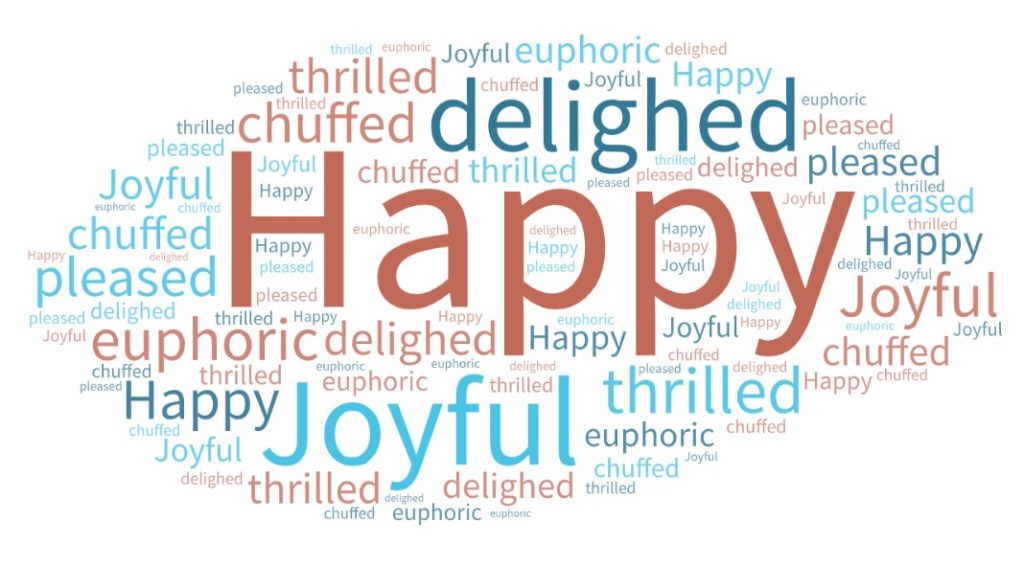
I realise that I sound like a real misery, but I passionately dislike the word ‘joyful’ (which I realise seems controversial when you consider it’s meant to convey a heart full to the brim with overwhelming appreciation and…joy).
My strong aversion to ‘joyful’ exists for a number of reasons.
Joyfully, is how Timmy would have greeted the Famous Five when they rocked up from boarding school for the summer hols. Nobody since then, and possibly not even then, has ever used joyfully to describe anything or anyone at all in common speech. For a second, just imagine going into a room and telling a group of people, “I felt so joyful yesterday, I could burst!” Literally no-one with an ounce of social awareness does this.
Secondly, joyful is how Carol singers are supposed to feel when they harmoniously regale us with details of the birth of Jesus and infuse our hallways with Christmas spirit. In practice, this is generally a more lack-lustre affair- if it happens at all – and carol singing with small children is challenging to describe as joyful when you’re worrying about lost gloves and the availability of the nearest toilet.
Nobody uses the word joyful ever. Not even at Christmas. No-one in 2023 would consider that this word is part of their active vocabulary. We don’t hear it. We don’t say it. Even so…. give a child a thesaurus and from that day forth, they are convinced, proud even, to be able to tell you that this word is a perfectly suitable synonym for ‘happy’ – and then proceed, merrily and against all advice, to never use it in any correct context.
The word joyful is a problem, but so is the thesaurus.
Search ‘happy’ and you are greeted with a plethora of words to choose from which include the potentially inebriated ‘merry’, the rather austere ‘gratified’ and for very happy, is the mysterious ‘happy as a clam’ (which definitely warrants further investigation because why a clam should be happier than any other shellfish, I’m not really sure).
So, faced with so many options, is it any wonder that children plump for ‘joyful’ as a proposed alternative to ‘happy’?
The underlying issue is that we ask children to ‘up-level’ their vocabulary using a thesaurus. However, there are two issues with this approach. The first is that the synonyms in a thesaurus only share an approximate meaning with the word searched, and secondly, many of these words are not up-levelling vocabulary to a more ambitious word at all. Merry could hardly be described as being a more ambitious alternative to happy, neither could joyful for that matter.
Listed synonyms which could be perceived as being uplevelled alternatives might include: delighted, elated, euphoric or exhilarated. However, a cautionary tale awaits here too. ” Thomas was happy to see his friends” has a very different meaning to ” Thomas was euphoric to see his friends.” Whilst the first example suggests that Thomas was mildly relieved to see his friends, the second example suggests that Thomas’ friends were about to save him from certain death.
A potential solution to this word selection issue, is to consider what the word ‘happy’ actually means in the context of the sentence. What had happened to Thomas before he saw his friends? Why were they there? Ask the children to express in their own words how Thomas was feeling and why. Some of the children’s expressions will start to eliminate many of the synonym suggestions from the thesaurus. Many suggestions may provide phrases such as ‘ his heart started to beat quickly’ which by reason of inference, is an automatic improvement on ‘happy’ in any event. If vocabulary is to be up-levelled, precision in the meaning of the vernacular word is key to avoid changing the meaning of the sentence by substituting an inappropriate word. Furthermore, there is a danger that if we leave children to substitute exciting sounding words, such as euphoric, just because they are ambitious, we are creating misconceptions that all synonyms are appropriate substitutes in any context, which is clearly not the case.
For the avoidance of doubt, joyful is, in my view hardly ever going to be an appropriate substitution for happy and will continue to make me shiver to my core, unless, of course, we happen to one day be writing in the style of upper class 1950s carol singers, then I will embrace it wholeheartedly…with unabated joy.
 Bring colour to a monochrome journey
Leave a comment