
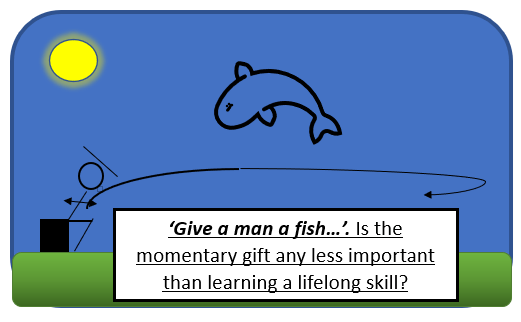
Give a man a fish and you feed him for a day; teach a man to fish and you feed him for a lifetime.
From Lao Tzu to Oxfam’s 2007 fundraising campaign, the received wisdom of the “Give a man a fish” proverb has been to educate the world’s population into understanding that providing one-off gifts of charity are merely a transient fix in the lives of disadvantaged people, which should, implicitly, be avoided in favour of providing a lifelong gift of skill or trade, which would enable those people to become self-sufficient. Throughout the year, many families in Britain rely on one-off donations, subsidies and services which provide necessary support to themselves and their children. Likewise, many families benefit from high quality teaching in schools, and education programmes which provide both children and adults with skills and qualifications which they can use in the future. The proverb, Give a man a fish.. would have us believe that the former should be removed in favour of the latter, in order to create a system of long-term sustainability, however, is that actually the case or are the two situations equally as essential for long-term growth?
The fish
With the arrival of the school holidays, and the continuation of the seemingly endless ‘Cost of Living Crisis’, many households may be facing a dark financial black hole which, once again, spells a summer of hunger and misery for many children across the country. Whether or not the long summer holiday should exist at all in modern Britain, is itself a much debated issue and also one which is besmirched with a stain of irony. The summer holidays were once an essential part of the country’s economy and were a time when children were released from education to work on farms and businesses at home, in order to support their families to generate food and income. Children were essential workers and an integral part of the working year, so whilst the time off from school was granted, for many children, it was not actually a ‘holiday’ at all. As our society and culture has changed, there are very few children who are called upon to help with the family business, farming or otherwise and the summer break from education has morphed into a confusing and complex soup of optimism, relaxation, stress and boredom.
On the one hand the holidays bring the unabated joy of time outside the classroom. For many children there are the physical benefits of time outdoors during the longer Summer days; playing with friends who they don’t see in school; the opportunities to explore other interests and the mental health benefits of rest and relaxation which are lauded by teachers and students alike. As the school year rumbles into July there is the inevitable buzz of excitement that the school year is grinding to an exhausted halt and that everyone can do ‘something that they enjoy.’
On the other hand “Whilst this is true for many children, for some, the school holidays are a stressful and impoverished period of isolation, boredom, and inactivity (Blazer 2011). For llow-income families, summer holidays often entail increased financial pressures, food insecurity, poor health and exclusion from culturally enriching and healthful activities (Rai, 2015). Unequal access to and limited participation in such engaging activities means that many children miss out on interesting educational and developmental opportunities otherwise enjoyed by their more affluant peers (Blazer, 2011; Meyer eta al.,2004;Summer Learning Association, 2009a)” (Stewart, Watson and Campbell Childhood 2018. Vol 25(4) SAGE)
Furthermore “ Children from poorer families are more likely to report worse well-being compared to those from richer families. We also know that problems such as food insecurity and loneliness can have profound effects on mental health and well-being. In addition, there is some evidence that children and young people from low income families experience greater “learning loss” during the school holidays than their peers.” (Morgan and Moore, Cardiff University 2019)
We know that during the term time, many children rely on the routine, the warmth and the safe environment provided by school. From a mental well-being perspective there are a growing number of children for whom school is literally a life-saver, however, for many more, there are financial benefits to being in school of which they may be unaware, although their parents almost certainly appreciate.
If we are concerned with narrowing the disadvantage gap, the summer holidays are the perfect opportunity to see how, without the help and support of schools, that gap could (if left unattended) grow exponentially. In schools, children from low income backgrounds benefit from Free School Meals, ensuring that one for at least one meal a day, all children can eat a nutritionally balanced hot meal. Many schools go further than this and also provide breakfast, so that children are able to focus on their education in the morning without having to fight hunger. One of the functions of school uniform is to remove the pressure of having a variety of socially acceptable outfits at your disposal on a daily basis. Many schools and local authorities also have a system whereby pre-loved or donated uniform is available for parents who are struggling with cost. Each year, there are charitable funds made available by a variety of organisations which provide shoes, coats, transport. For schools which are alive to the possibility of these schemes, there is a great deal that can be done to provide struggling families with essentials. Disadvantaged children are given opportunities to join clubs and follow the same interests as their more affluent peers at no cost or minimal cost to their families. By looking the same and having the same opportunities as every other child, the stigma of being ‘poor’ is removed from children at an early age allowing them to flourish and have the high aspirations that they need, to achieve their potential in the future.
In the holidays, there are schemes available to provide similar levels of support. However, for many, accessing the support is more complex than in term time as different providers will have different registration requirements. There may also be transport issues to overcome. Since 2018, the government backed Holiday Activities and food Programme has been providing free meals and activities to disadvantaged children throughout the country. According to the Education Hub, Over 600,000 children attended HAF clubs last summer, benefitting from nutritious meals and enriching activities, which are targeted towards those who are eligible for free school meals. The scheme itself offers free hot meals and some fantastic opportunities for young people, however, not all the events are in the same location and parents may have to travel short distances which could be inhibiting for those without transport. There is also a registration process which some parents might find off-putting and less achievable than a drop-in scheme and whilst 600,000 children is a lot, it’s only approximately a quarter of the children in England who are eligible for Free School Meals. Whilst this is only one example of subsidised childcare throughout the summer, it opens a window into the lives of those children who rely on the certainty of school to provide them with the care that they need. For those without pro-active parents, prepared to fill in registration forms and arrange transport or for those without extended family who are available to step-in as holiday carers, the holidays become a barren wasteland of misery.
Teach a man to fish
The message of the proverb is intended to be clear and unequivocal: Teach a man a skill and he will gain future independence and become self-sustainable.
What is the attainment gap?
The poverty attainment gap is defined as the standardised difference between the attainment of a disadvantaged group and a not disadvantaged group of pupils. There have been some studies of the attainment gap which only looked at the picture since 4 S. GORARD 2011, when Pupil Premium started, and so they cannot genuinely say that any trend was not already in existence beforehand (e.g. DfE, 2018b) (Stephen Gorard (2022): Segregation and the attainment gap for permanently disadvantaged pupils in England, Educational Review, DOI: 10.1080/00131911.2021.2007055)
There is a wealth of data in relation to the attainment gap. According to data from 2022, the disadvantage gap index rose in 2022 to 3.23, up from 2.91 in 2019. The increase in the disadvantage gap may have risen for a number of reasons, one being the period of instability and school closure during the pandemic.
The EEF Guide to the Pupil Premium, provides schools with guidance on the effective implementation of a strategy to address the needs of disadvantaged learners in a setting and to use the Pupil Premium funding appropriately and advantageously. However, in order for these strategies to be successful, the recipient of this education needs to have three criteria already in place:
- The willingness to learn the skill;
- An appreciation of the value of the skill;
- The skill needs to be sustainable in the future.
1.Willingness to learn
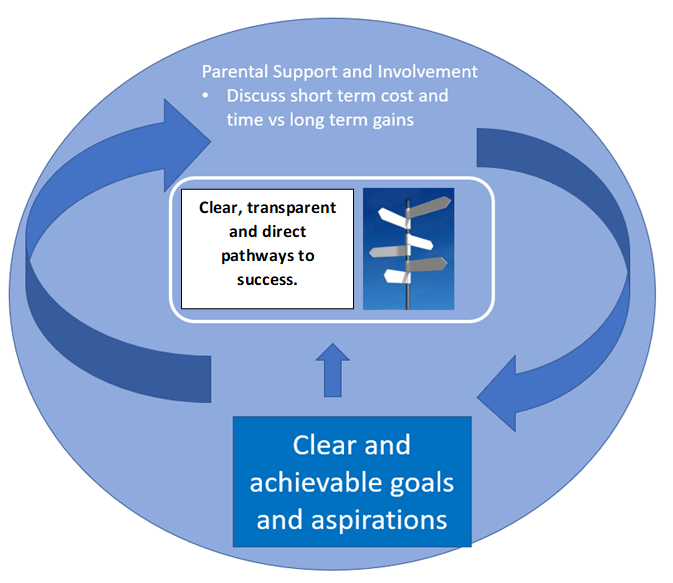
In order to learn, the learner has to be a willing participant. Through quality first adaptive teaching, the love of learning can be generated and fostered, ultimately leading to self-motivated independent learners. High aspirations are key to this willingness and together with the backing of family, learners need to know what their ultimate outcomes and goals are, in order to see the value in what they are being taught. The attitudes of the young people are key, yet the attitudes of their families may prove to be even more important in establishing how motivated they will prove to be as learners.
2. An appreciation of the value of the skill.
There is no value in teaching a man to fish if he doesn’t know that he lives close to water. The same is true of education. In order to see the value in what is being learned, learners need to see the big picture and to know how the links are made. Schema building and linked concepts within curricula create the big picture to which children should be signposted to continually. Creating the big picture and building on previous knowledge and skills enables children to develop their thought processes and to absorb concepts, which ultimately they will have the resources to reflect upon and challenge.
3.The skill needs to be sustainable in the future.
Learning how to fish is a pointless task if you can’t afford to replace broken equipment or travel to the water. In closing the attainment gap, we need to be certain that we are not only providing young people with the knowledge and skills that they need to achieve now, but also knowledge and skills that they can apply to situations throughout the remainder of their lives. The ability to clearly articulate thought; to organise an argument; to research the unknown and to use prior knowledge to make judgements and suppositions by applying reasoned thought is as essential as the learning itself. Having a wealth of knowledge but no medium through which to apply that knowledge is as useless as an absence of the knowledge itself.
Through the effective application of strategies to close the attainment gap, the gap will close, however the purpose behind closing that gap should not be lost. The three criteria above need to be met and for the gap to be closed successfully in the longer term, and for equity and equality to be created for those who may, through no fault of their own, have encountered socio-economic disadvantage. ‘Teaching a man to fish’ should be motivational, aspirational and sustainable for those seeking to achieve their goals.
Conclusion
The ’fish’ that schools are providing everyday, are an essential part of many people’s lives. Without the ‘fish’, many children cannot begin to care about the future, or improving their academic prowess. Without implementing effective and appropriate strategies to closing the disadvantage gap, the fish becomes a transient gift which holds only a momentary value. The two are not mutually exclusive. Closing the disadvantage gap is a much about filling the material gaps in the here and now as it is about filling the academic gaps for the future.
 Bring colour to a monochrome journey
Leave a comment