
According to research carried out by The Bell Foundation, although many EAL learners recognise familiar notation in Mathematics, “for the majority of EAL Learners there is still a lot of English required to access Maths lessons, and an understanding of the key features of mathematical language is essential for success in the subject. Word problems are a particularly challenging area.” (The Bell Foundation, Teaching English as an Additional Language (EAL) Learners in Maths).
In this context, the Bell Foundation’s report was focussed specifically on the teaching of Mathematics, however across the curriculum, there are vocabulary challenges for EAL learners which create an invisible but removeable barrier.
Word level
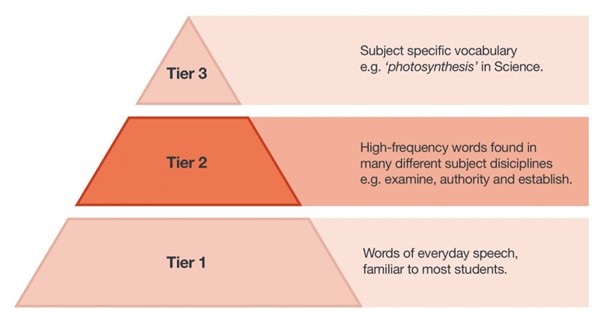
(Image: EEF, Improving literacy in Secondary Schools Guidance report)
Through immersion in English classrooms, the everyday language development of EAL learners is relatively quick. Through interaction with their peers, EAL learners can develop a functioning understanding of Tier 1 language which is sufficient for everyday social and practical purposes. However, even at an everyday level, EAL learners struggle through failure to acquire vocabulary which relates to a non-educational context, or, as The Bell Foundation note, a different cultural context. Words which we may consider to be Tier 1 and ‘everyday’ such as carousel, candyfloss stall, hook—a- duck, or ghost train, may not resonate in any way with a learner from a different culture therefore, progress may be inhibited through lack of contextual comprehension rather than Mathematical, Scientific or historical competence. For example, a child faced with a worded problem about the amount of money spent on hook-a-duck may not necessarily have the same mental image in mind.
Similar issues could arise in reading, where using strategies to discern the meaning of an unfamiliar word in a text, such as: finding a root word, replacing a word, or reading around the word could prove impossible.
In the sentence, “George celebrated at the hook-a-duck stall.” The unfamiliar context of hook-a-duck, would potentially prevent any children from fathoming the meaning of celebrate.
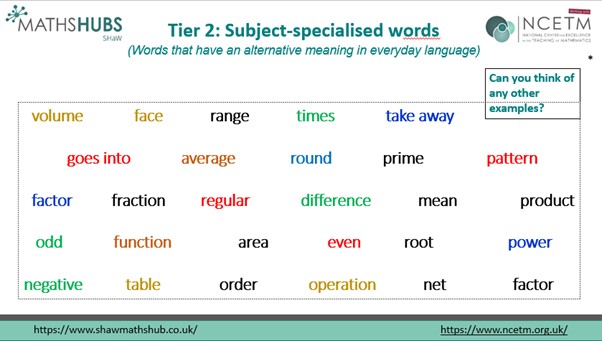
In Maths, similar complications arise in relation to Tier 2 vocabulary which may create confusion and misconception through multiple meanings, such as:
Strategies – The Pre-Teach
In July 2017, Babcock carried out a research project in conjunction with Devon County Council and the Maths Hubs to measure the impact of pre-teaching mathematical vocabulary in advance of maths lessons. In their Summary of Findings, the report states that “The impact has been extraordinary.”
The project specified that in order to be effective, the pre-teach should be delivered by the class teacher and time should be allowed for not only the teaching of vocabulary but also a discussion of the learning, which in itself provides additional learning opportunities.
The pre-teach of vocabulary (prior to each unit of work) to the whole class, is an adaptive strategy which supports and develops the confidence of all children in the class and ensures that all children have access to the same provision and opportunities. By focussing a pre-teach on a small number of children, there is an inherent risk that gaps could be forming in the knowledge (of Tier 2 and 3 vocabulary) in the remainder of the class. In essence, the pre-teach is a vocabulary lesson and should be treated as an opportunity to develop vocabulary across the curriculum, rather than as a burden the teaching timetable.
The Graphic pre-Teach
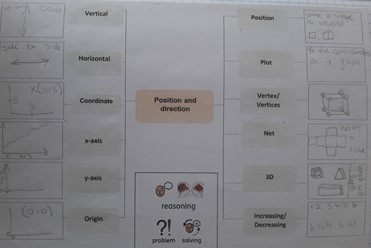
The Graphic pre-teach enables students to create their own vocabulary organiser using words or symbols which have resonance for them with a view to developing understanding of the words and concepts being taught. The pre-teach allows for a discussion of the concepts and units being taught together with the vocabulary commonly associated with that unit. The student is encouraged to use the empty box to create a visual reminder of the meaning of each word which is meaningful to them, thereby creating a powerful ownership over that vocabulary and their understanding. The Pre-Teach below referred primarily to position and direction, but also overlapped with a unit on shape. Through discussion, the student created images which would act as a visual reminder throughout the unit of work of the more complex Tier 2 and 3 vocabulary which she would encounter.
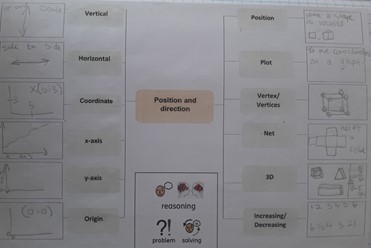
As the unit of work progresses, this also becomes a scaffold for the student’s learning which they can reflect on and refer to.
Throughout the pre-Teach, the role of the teacher is to develop the students’ understanding of the vocabulary on four levels.
Introduction of the word – I say, you say
The introduction of vocabulary is a key stage in language acquisition. By repeating the word, students become accustomed to hearing the word and also its pronunciation.
The word then shifts from being a word that they have never encountered to one which is ‘known about’.
Reading the word in context
What does this word mean? Do we know any other words with the same root? Can we think of any words which are similar? Can we read around the word in a contextual sentence? Can we replace this word to ascertain its meaning.
These strategies of Vocabulary acquisition and the deciphering of meaning link to the reading strategies of Kala Williams Blog List – ReadMaster and can be applied in any area of the curriculum.
Using the word in context
Using sentence stems and stem sentences, the word can then be applied by students in context. By being given the model to explain their thinking and to using vocabulary correctly, students are then being given the tools to expand their mathematical reasoning and explanation skills. In their written reasoning, students will write as they speak, therefore, providing high quality models of formal oracy skills, students are practising in speech, phrases which they will eventually use in the context of problem solving.
Embedding learning
Learning new vocabulary is a continuous process, however, without application, any new vocabulary learned will always sit on the fringes of our consciousness. Referring to learned vocabulary frequently (and in context), displaying that vocabulary and encouraging students to record and refer to previous vocabulary learned will help to embed their learning. Through exploration of words, their uses, their etymology, their synonyms, antonyms and their application, students will begin to retain that knowledge for longer periods of time.
The pre-teach, although easily perceived as a snapshot in a week’s learning, is a document to be referenced throughout a unit of work and to be linked throughout the wider curriculum. For example, a Venn Diagram has multiple uses across the curriculum and can be referenced at different stages through a student’s learning journey, as can many other mathematical terms. A horizontal axis in maths may be the starting point, however with a deeper knowledge of the word horizontal, it can also be applied metaphorically in creative writing.
In a highly pressurised timetable, a pre-teach by the class teacher can easily fall by the wayside, however it should not be underestimated how important this tool is, in improving a student’s vocabulary, their confidence and to assigning competence to their learning.
 Bring colour to a monochrome journey
Leave a comment