
The phrase ‘high aspirations’ is used liberally in education and in particular in relation to disadvantaged children. For anyone concerned for the well-being of young people, it would be inconceivable to argue that children should not have high aspirations, therefore, saying that you wish to promote high aspirations is a safe bet. The question is, what do we actually mean by this phrase? Why do we want all children to have high aspirations, what would this look like in reality and how do we ensure that these high aspirations are achievable dreams and not insurmountable challenges?
Do children automatically have high aspirations?
According to the EEF, the answer is yes.
Some studies have shown that most young people already have high aspirations, suggesting that much underachievement results not from low aspiration but from a gap between aspirations and the knowledge, skills, and characteristics required to achieve them. Where pupils do have lower aspirations, it is not clear whether targeted interventions have consistently succeeded in raising their aspirations. Also, where aspirations begin low and are successfully raised by an intervention, it is not clear that an improvement in learning necessarily follows. (EEF, Aspiration Interventions)
Young people are, in the main, naturally aspirational. With no clear understanding of the path that they need to take, or the sacrifices that they may need to make, any number of children at any one time, from any background, will tell you that they are going to be a Premiership Footballer, a Prime Minister or an astronaut.
Why is it then that the aspirations of these children dwindle by the age of 18?
According to the Big Issue
Only 16.2 per cent of free school meals pupils received an undergraduate degree between 2002 and 2019. That’s in comparison to nearly a third (28.2 per cent) of state school students who weren’t eligible for free school meals, and well over half (57.3 per cent) of independent school pupils.
The likelihood of free school meals students doing a masters degree is just 3.3 per cent, while one in five private school students (20.6 per cent) went on to study for a masters.
In 2014, the DofE carried out an investigation into School and College level strategies to Raise aspirations of high achieving disadvantaged pupils to pursue Higher Education.
One of the barriers to pursuing higher education was cost, however that was not the only barrier.
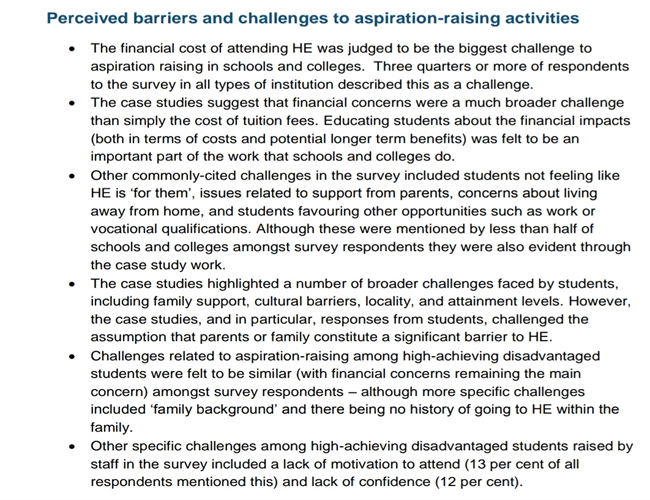
One of the key concerns that young people had was lack of understanding of the benefits of higher education. Particularly in cases where no one else in the family has gone to university but have nevertheless survived successfully, without the burden of student debt, it is easy to see why this might be the case.
Why would there be an aspiration to be educated to degree level if there is no appreciation of the qualification?
Why then, should one of the high aspirations of a pupil premium child be to undertake Higher Education?
The Big Issue report noted that over 57% of privately educated children did go on to higher education.
The obvious difference (aside from cost) is the culture within the home.
When we ask children what aspirations they have and what they would like to do, children think of jobs which are visible to them. The Premiership Footballer, prime minister and astronauts are on TV regularly. Social Influencer or Youtuber is another popular aspiration.
Less children, however, will say that they dream of being a cardiovascular surgeon, a chartered surveyor, an accountant, a biochemist or a civil engineer and yet statistically, they have a far higher chance of entering these professions than being one of a handful of English players to play consistently in the Premiership.
The reason is lack of knowledge that these jobs exist and even less knowledge of the path needed to take to secure them.
The parents of privately educated children may be in these professions themselves, as they are statistically more likely to have a university degree to be able to gain a profession where school fees are a possibility, therefore, they feel, first hand some of the benefits. They can guide their children confidently along the higher education path towards their chosen career and ensure that their dreams are realised.
To the parents of some pupil premium children, however, the benefits are neither obvious nor attainable and the route there is a murky tunnel of uncertainty and form filling. To be fair to them, even to confident form fillers, the quagmire of Student Finance is an unappreciated and tiresome annual chore.
The route to changing the perspectives of pupil premium children from “why should I?” to “How can I?” is by being clear and transparent from the outset.
Provide children with opportunities to learn about an abundance of career opportunities; clearly set out the path that they will need to take to get there and involve families to facilitate the discussions of long term benefits vs short term cost and time.
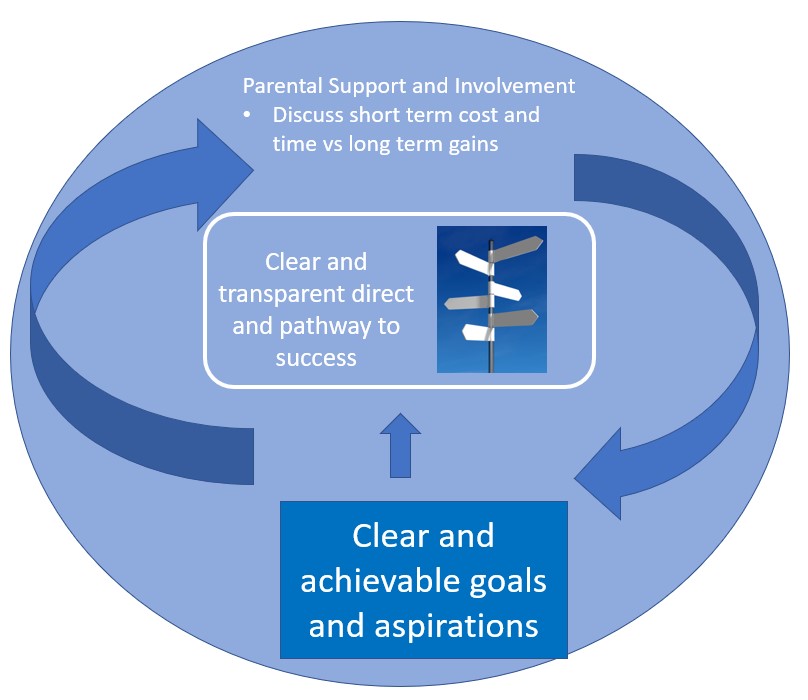
If you don’t know where the trains are going, how do you know which platform to stand on?
If you know where you’re going, you can check the timetable and make sure that you are on the right platform.
 Bring colour to a monochrome journey
Leave a comment