
Reading for Pleasure and what strategies we can use.

The world spins at approximately 1000 mph; the average broadband speed in the UK appears to lie somewhere between 50 and 80 Megabits per second (depending on which statistics you read); Amazon Prime can deliver a parcel the next day (the same day, if you’re organised); Games and music can be downloaded within seconds.
Everything is fast. Everything happens now. Everything is immediate.
Children and adults alike, expect that there will be miracle solutions to any issues, which will take no time at all. We are living in a ‘Black Mirror’ world where waiting and taking time over something, has become the pariah of progress and development. But, at what cost?
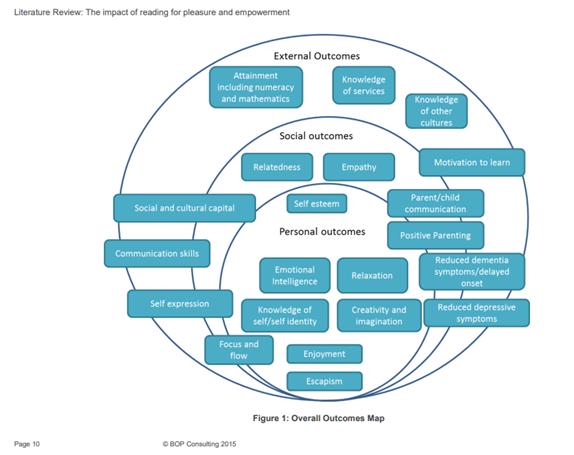
According to a literature review commissioned by The Reading Agency and conducted by BOP Consulting between March and June 2015, reading for pleasure and enjoyment provides an extensive range of positive outcomes in children, parents and adults alike.
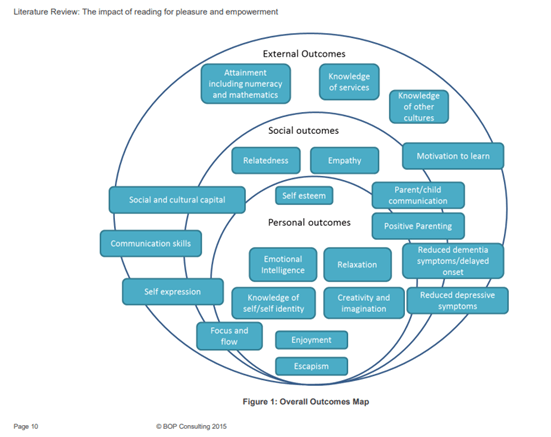
These outcomes provide compelling evidence that reading for pleasure should form an essential part of our social, emotional and educational development. However, it takes time (more time than downloading a game; music or a film) and it demands active participation from the learner, rather than the passive interaction required by a podcast or an audiobook.
As adults in a world where everything is immediate, where notifications ‘ping’ every second and where every timetable is crammed to the gunnels with objectives and requirements, we need to accept that some things take time. In order for us to enable high aspirations and ambitions to flourish in young people, we need to encourage children to read for pleasure: we need to educate both the children and their parents that it is acceptable, necessary even, to stop, reflect and take time to allow their minds to freely wander through the images and escapism of a book – without guilt.
The Role of Parents in reading for Pleasure
In 2012, The Department for Education, Education standards research team released the findings of their study Research evidence on Reading for Pleasure. One of the first key recommendations of the D of E was:
Parents and the home environment are essential to the early teaching of reading and fostering a love of reading; children are more likely to continue to be readers in homes where books and reading are valued (Clark and Rumbold, 2006).
Furthermore
Having access to resources and having books of their own has an impact on children’s attainment. There is a positive relationship between the estimated number of books in the home and attainment (Clark 2011). Children who have books of their own enjoy reading more and read more frequently (Clark and Poulton 2011)
For teachers (and many parents), these findings are anything but surprising. For those of us who spent years filling our homes with books and dedicating hours to the ‘Bedtime Story’ this finding only reinforces what we already knew – that reading at home, talking about books and encouraging a love of reading will be beneficial to our children’s development and will give our children opportunities such as those identified by The Reading Agency.
But where did this knowledge come from? It didn’t come from internet searches or extensive research. In many cases, it came from our own parents and we were simply repeating a learned cycle of behaviour.
In many children’s lives, that learned cycle of behaviour is missing. Maybe their parents didn’t or couldn’t value reading because they were denied those opportunities, possibly because their grandparents were also missing those opportunities. These children, however, are still expected to attain in line with their peers in terms of vocabulary acquisition and writing skills and are measured with same tools. They are expected to reach a goal which is already insurmountable through no fault of their own or their families.
In addressing the disadvantaged vocabulary gap and the reading gap, the first step of a schools’ plan, has to be parental involvement from a very early age.
Parents need to be educated in the routines of reading for pleasure and the ‘Bedtime Story’. Inviting parents into school in the Early Years and beyond to share in the joy of reading is the first essential step in a a child’s journey. If parents don’t value reading, evidently, the children won’t. Can we set up parent ‘reading with children’ classes to fill their gaps? Use Book Swaps to send books home? Use translation tools or duel language books to help parents whose first language isn’t English? Promote reading in their First Language by signposting parents to services where those books are available?
We know that:
Reading for pleasure is strongly influenced by relationships between teachers and children, and children and families (Cremin et al, 2009)
As schools, we can foster and develop the reading relationship between children and their families, what of the relationship between reading for please and school?
Reading for pleasure in school
The Dof E’s finding in repect of schools were:
• An important factor in developing reading for pleasure is choice; choice and interest are highly related (Schraw et al, 1998; Clark and Phythian[1]Sence, 2008)
• Literacy-targeted rewards, such as books or book vouchers have been found to be more effective in developing reading motivation than rewards that are unrelated to the activity (Clark and Rumbold, 2006).
• Reading for pleasure is strongly influenced by relationships between teachers and children, and children and families (Cremin et al, 2009)
The curriculum should be heavily underpinned by reading. In her recent book, Simplicitus, Emma Turner https://twitter.com/Emma_Turner75 notes that:
Reading needs to be at the heart of the primary curriculum. We know that being a successful reader is key to future academic success and also to subsequent adult health and wellbeing. It is our duty as primary educators to ensure that as many children as possible become not only proficient and fluent readers but avid and accurate readers, both for please and purpose. (E. Turner, Simplicitus, 2022 John Catt Educational Limited).
Schools need to ensure that the reading for pleasure is actively promoted and that time is found in a busy curriculum to enable to children to explore what they enjoy and to discuss what they enjoy reading. Inviting parents into school to read with their children add value. Reading with children individually adds value.
In his article Who Should Read Aloud in Class, Alex Quigley https://twitter.com/AlexJQuigley has proposed approaches to replace Popcorn Reading in order to develop fluency (and therefore enjoyment)
It is important to state that pupils do need to practise reading aloud if they are to develop and improve their own reading fluency. What evidence-informed strategies can help this aim?
Professor Diane Lapp, from San Diego State University, in the categorically titled, ‘If you want students to read widely and well – Eliminate ‘Round-robin reading’, suggests the following approaches:
- Repeated reading, which involves repeating a reading modelled first by the teacher or another proficient reader.
- Choral reading, which means reading together with others who are proficient readers.
- Echo reading, or the student echoing or repeating what the proficient reader has just read.
- Readers’ Theatre involves a dramatic reading of a text or script by the students.
- Neurological impress, which involves the student and teacher reading together while tracking words.
Let’s put away the popcorn, retract RRR, and put efforts into teacher-led reading and a purposeful focus on fluency-building practices.
Who should read aloud in class? (theconfidentteacher.com)
Targeted reading also works very successfully, selecting those children who do not read at home to read individually to a teacher or to a class, boosts self-esteem and a love of reading. With a carefully disguised list of who I ‘need’ to hear read, I ask every day “Who wants to read?”. From a cagey start which involved only the most confident readers, the room is now awash with enthusiastic hands and voices, “Me.Me.me.”
The benefits of Reading for Pleasure are well documented. It is essential that the next generation of readers are not lost in tight time scales and the immediacy of technology but learn to sit back and appreciate the joy of reading…just because they can.
The Reading for Pleasure train in schools needs to leave the station and begin the journey.
 Bring colour to a monochrome journey
Leave a comment