
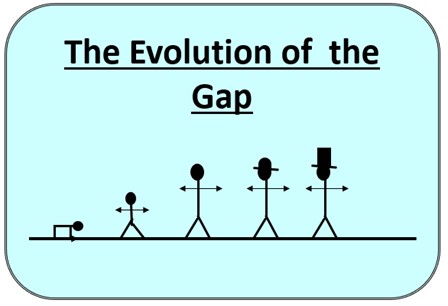
Anyone who has a knowledge of British History since 1066 (or a passing acquaintance with Blackadder) should, with some confidence, be able to describe a Feudal system in which society was designed as a pyramid. The Monarch sat supreme at the top of the pyramid, second only to God. Beneath, wealthy landowners paraded in resplendent leisure and privilege, initially as a reward for their service to the Crown, and later, courtesy of their right to rule, ascribed to them by fortune of birth. These wealthy landowners, leased land to vassals, who managed the land, by directing and organising other people to do all the hard work for them. At the very bottom of the pyramid sat the people who did all the actual work to keep the estates and the country running smoothly, rewarded only by the occasional turnip and the right to fight for and die for their nobleman, should the need arise.
So successful was the design of the feudal system that it has endured for almost a thousand years. The basics of modern organisational structure reaffirm the belief that the society we live in, essentially remains a by-product of Norman Britain and whilst the Norman churches are celebrated for their longevity, it was something more fundamental to human nature – the notions of superiority, power and hierarchy that the Normans left as their true legacy.
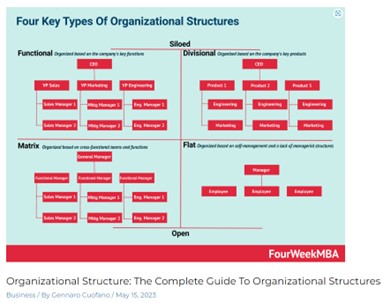
It could be argued then, that the disadvantage gap began to form as a consequence of Norman social policy. At the point when some people were singled out to receive wealth and splendour whilst others boiled turnip soup and battled life-threatening malnutrition, the great divide sprang wide open.
Since 1066, the class structure in Britain has shifted, wealth has beome more widely distributed. Privilege of birth is no longer the sole path to the accumulation of financial gain. Barriers to success in modern Britain, however, remain, firmly entrenched by the ‘Haves’ and increasingly inaccessible to those who ‘Have not’.
In 2010, the Coalition Government released their Programme for Government
12. EQUALITIES The Government believes that there are many barriers to social mobility and equal opportunities in Britain today, with too many children held back because of their social background, and too many people of all ages held back because of their gender, race, religion or sexuality. We need concerted government action to tear down these barriers and help to build a fairer society.
(The Coalition: Our programme for Government, Cabinet Office, May 2010)
In terms of education, this vision statement led to the introduction of the Pupil Premium.
26. SCHOOLS The Government believes that we need to reform our school system to tackle educational inequality, which has widened in recent years, and to give greater powers to parents and pupils to choose a good school. We want to ensure high standards of discipline in the classroom, robust standards and the highest quality teaching. We also believe that the state should help parents, community groups and others come together to improve the education system by starting new schools.
• We will fund a significant premium for disadvantaged pupils from outside the schools budget by reductions in spending elsewhere. (The Coalition: Our programme for Government, Cabinet Office, May 2010)
Since it’s introduction in 2011, the progress and attainment of socially and economically disadvantaged children has been carefully monitored.
Whilst, not all children who receive Pupil Premium funding demonstrate lower attainment than that of their peers, in 2022/2023, it is evident that (even with the complexities of comparing data through Covid-19) there is little evidence that the Pupil Premium funding is having any demonstrable impact, indeed, it appears that the attainment gap is continuing to rise.
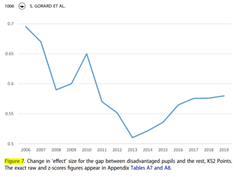
Pupil Premium funding has been provided to schools in England since 2011, to reduce socio-economic segregation, and the attainment gap between disadvantaged pupils and their peers. There is little evidence it works.Stephen Gorard, Nadia Siddiqui & Beng Huat See (2022) Assessing the impact of Pupil Premium funding on primary school segregation and attainment, Research Papers in Education, 37:6, 992-1019, DOI: 10.1080/02671522.2021.1907775
 Bring colour to a monochrome journey
Leave a comment