
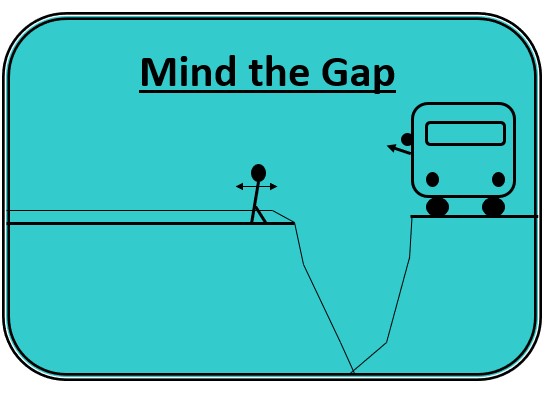
‘Mind the Gap’, a phrase initially coined in the 1960’s to warn travellers of a potentially fatal hazard which was built into their journey, has become synonymous with the perils of taking the dark and daring step from the edge of the platform (where any misjudgement could be your last misjudgement) to the relative safety of a moving vehicle which will whisk you off at 80 mph to any destination you choose.
In schools, the ‘Gap’ has come to represent the inequalities in the system, created by social and economic disadvantages, which are faced by an increasing percentage of the population and which, ultimately, prevent learners from reaching increasingly unachievable targets. The metaphor of the train has a blunt but synchronistic harmony with the plight that many children in England today, face when trying to navigate their way through educational and social hurdles.
In education, as in rail travel, the notion of the ‘Gap’ being a potentially life-changing hazard is all too real. At day one, we are all born, ostensibly, with the same opportunities for growth, development and achievement. At day one, we all read the departure timetable with the same eyes and dreams of boarding the train. Imagine then, the disappointment of realising that by the age of two, you are already watching others board the train, while you are still trying to find the platform. By the age of three, you have managed to find the platform but you are running late, and can hear the doors closing. When you finally arrive at the platform edge, at the age of nine, you are asked to ‘Mind the Gap’, but the gap now is a vast ravine which you cannot cross without assistance. The doors are closed. The train is moving. Powerless to cross the gap, you are stranded on one side of an insurmountable hurdle: a life-changing divide. As you watch the train leave, you become aware that other children ‘knew something that you didn’t’, and were privy to a secret which no-one has shared with you. They are on their journey to the Faraway Tree land of Aspiration, Ambition and Dreams-Come-True, whilst you are perched helpless and frustrated, on the edge of the looming gap waiting for someone to show you how to cross.
The reality is, that this gap is clearly seen and understood by children from a young age. There is a distinct ethos of defeatism in the very young, who already know that society has evolved to ensure that they can’t cross this figurative gap without a solid support structure, as a consequence, they lack the self-esteem, and aspirations to try.
According to the Joseph Rowntree foundation, in 2020/2021 approximately 1 in 5 families were living in poverty.
Since then, the impact of the cost of living crisis on normal daily life has been laid bare in JRF’s latest cost of living tracker, conducted in late October and early November 2022:
- half of the poorest fifth of families say they have reduced spending on food for adults
- around four in ten families with children are spending less on food for their children
- half are already reducing the number of showers they take
- around six in ten are heating their home less.(JRF UK Poverty 2023)
This figure is supported by the government’s data which shows that:
Free school meal eligibility continues to increase
22.5% of pupils are eligible for free school meals, up from 20.8% in 2021. This represents just under 1.9 million pupils.
(Department for Education (DfE) Explore Education Statistics, Academic year 2021/22 Schools, pupils and their characteristics)
For children experiencing economic deprivation, comes hardship and there is a re-aligning of priorities for families and children alike. Surviving day-to-day takes priority over education and for many children in the UK, one of the most developed countries in the world, the journey to the platform alone will be challenging enough without giving any thought to the hazards looming at it’s edge.
Ultimately, the issue of the widening gap is a vast challenge which requires innumerable changes to resolve. In the short term, the responsibility has been given to educators through Pupil Premium Funding to find a solution. The purpose of this blog is to identify the background challenges faced by Pupil Premium children; to discuss the social and economic realities with which they are battling; to consider the options available to schools; to provide a succinct and clear model which schools can use to narrow the gap and to ensure that high expectations and aspirations are a standard feature of all children’s lives, not merely a perk of privilege.
 Bring colour to a monochrome journey
Leave a comment